
Quick answer: Bully sticks are made of one ingredient: beef pizzle, the muscle of a bull’s or steer’s penis. The muscle is cleaned, shaped and dried or baked for roughly one to three days into a hard, digestible chew that doesn’t splinter. A good bully stick lists nothing else on the label (American Kennel Club; Bully Bunches).
If you’ve just opened a bag of bully sticks and wondered what you’re actually holding, you’re not alone. When researchers at Tufts and the University of Guelph surveyed 852 people, only 44% of general respondents and 62% of veterinarians correctly named the source (Tufts University; Fox News report on the study).
This guide explains what bully sticks are made of for dogs, how they’re made, what separates a good stick from a poor one, and why they cost more than you might expect. It also covers why dogs go after sticks from the yard, and what to offer instead.
What are bully sticks made of?
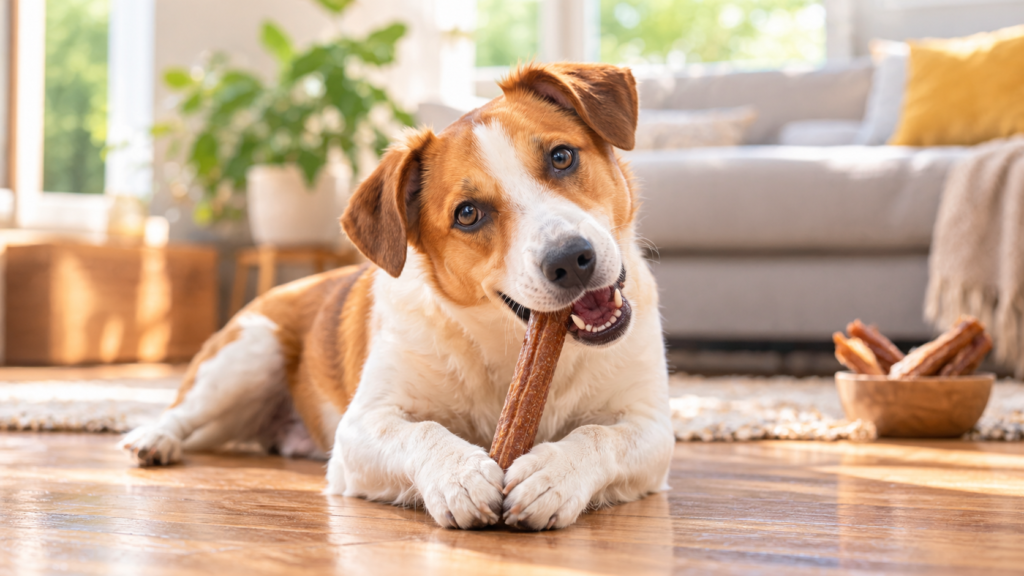
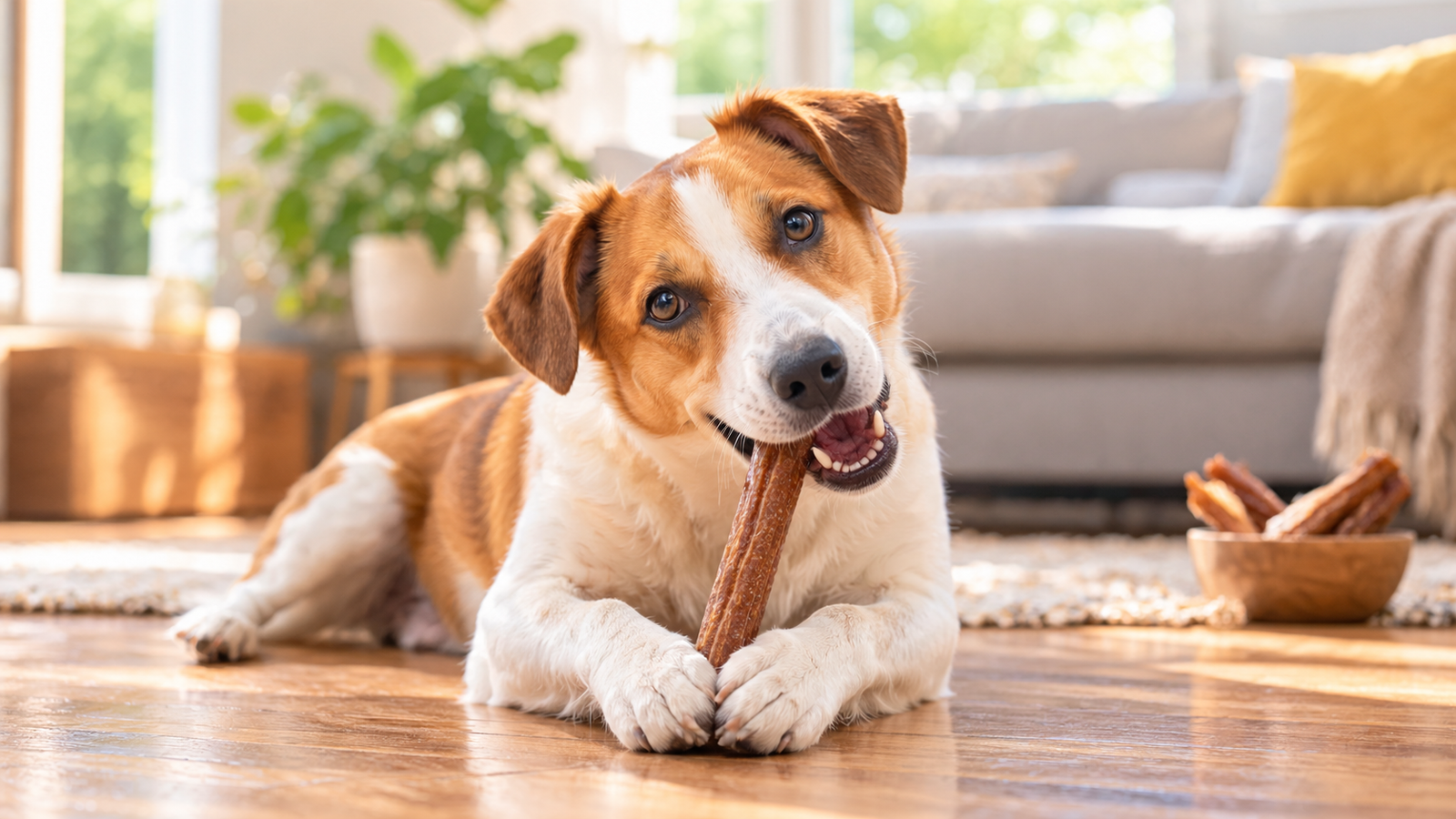
Bully sticks are made of beef pizzle, which is the penis muscle of a bull or steer. It’s one animal part and one ingredient, with no grains, binders or meat blends.
The AKC describes it as a single-ingredient treat made from high-protein beef muscle. It’s digestible and doesn’t splinter the way bones can. You’ll see it sold as pizzle sticks, beef pizzle, steer sticks or bull pizzle. They all mean the same thing (Chewy).
Three things worth knowing:
- It’s muscle, not bone or hide. That’s why bully sticks behave differently from bones and rawhide.
- It’s a byproduct. Australian treat maker Bonza Dog Treats notes pizzle is generally considered an animal byproduct, and Redbarn says it uses parts that might otherwise be discarded.
- It’s sold in different states. Pizzle sticks are sold raw, dried or cooked (Chewy).
What are bully sticks made out of besides pizzle?
Nothing, if the stick is plain. But brands don’t all agree on what “plain” means. Bully Bunches says traditional sticks get no flavoring and are only salted by the pizzle’s natural salt, while noting that some makers now add salt, wood smoke or other flavorings. Bully Sticks Direct, by contrast, says added salt is a sign of an inferior base material.
The practical answer: read the label. If it says anything beyond “beef pizzle” or “bull pizzle”, it’s a flavored or treated product.
What’s the nutrition?
Brand figures vary, so check your pack:
- Protein and fat: one US brand’s label lists 80% crude protein, 2% fat, 1% fiber and 0.9% moisture (Jack’s Premium). Bully Sticks Direct puts crude protein at 80-90% of dry weight and fat at 2-7%.
- Calories: a study in the Canadian Veterinary Journal (Freeman, Janecko and Weese, 2013) tested 26 sticks and found 9 to 22 calories per inch. The average 6-inch stick was 88 calories (Tufts University).
- Amino acids: the AKC notes beef muscle is a complete source of amino acids.
How are bully sticks made?
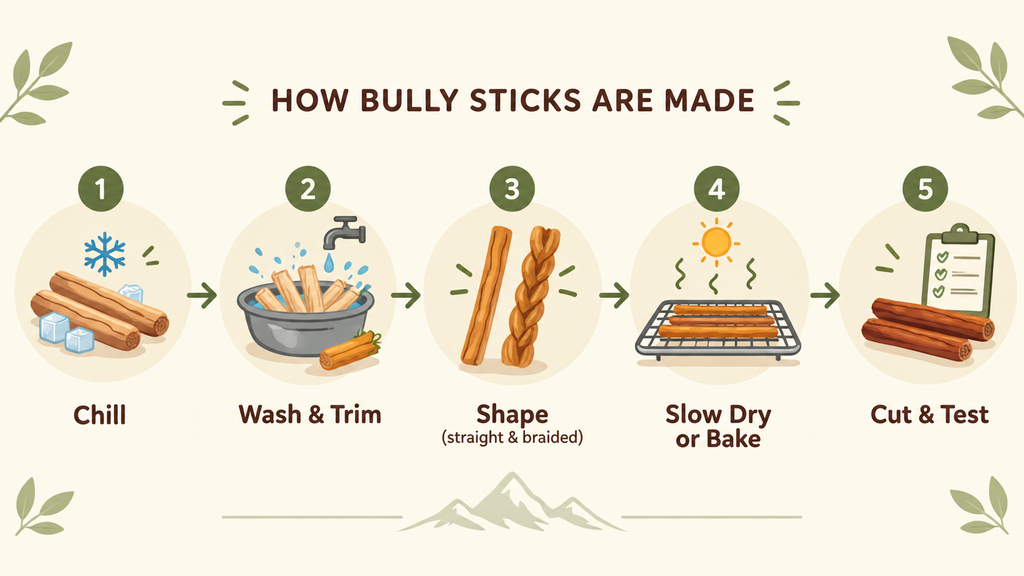
Bully sticks are made by cleaning raw pizzle, shaping it, then slow-drying or baking it for roughly one to three days. Processes differ slightly between makers.
- Collect and chill. Pizzle is a byproduct of cattle processed for beef. One manufacturer says its pizzles are refrigerated, then frozen, until processing (Tuesday’s Natural Dog Company).
- Trim and wash. Fat is trimmed, fluids are drained and the pizzle is washed in clean water for a few hours (Bully Bunches). Bonza notes each stick is prepared by hand to remove fat.
- Shape. Sticks are left straight or formed into braids, knots, springs or rings.
- Dry or bake. Bully Bunches says it hangs the sticks and dries or cooks them at 165-195°F for 2-3 days. Bully Sticks Direct gives 24-72 hours depending on thickness.
- Cut, sort and test. Sticks are cut to length, usually 6, 9 or 12 inches, and sorted by thickness. Some makers lab-test batches.
A note on odor: blood and urine are water-soluble, so one maker says hot-water washing removes most of the smell, and hanging the stick to bake lets the rest drain (Tuesday’s Natural Dog Company). Odor-free sticks usually just get extra washing or longer drying (Jack’s Premium). Even then, chewing re-wets the stick and the scent can return (Bully Bunches).
What are dog bully sticks made of? Types and variations
All bully sticks contain the same beef pizzle. The differences are thickness, shape and processing (Bully Sticks Direct).
| Type | What it is | Good for |
|---|---|---|
| Standard straight | Single dried pizzle, usually 6 or 12 inches | Most dogs |
| Thin / junior | Thinner sticks, often from smaller or younger animals | Small dogs, puppies |
| Thick / jumbo | Denser sticks from mature animals | Large or strong chewers |
| Braided | Several sticks twisted together (Redbarn says three) | Heavy chewers |
| Curly, springs, rings | Different shapes, same ingredient | Variety and engagement |
| Odor-free | Washed and dried longer | Indoor chewing |
Why are bully sticks so expensive?
Bully sticks cost more because supply is limited and the work is hands-on. Bonza lists three reasons: each bull has only one pizzle, so there are fewer than other beef parts; each stick is trimmed by hand; and dehydration takes two to three days. Demand also often exceeds supply. Very cheap sticks may have cut corners in sourcing or processing, so don’t judge by price alone.
How do bully sticks compare with other chews?
| Chew | Made of | Notes |
|---|---|---|
| Bully stick | Dried beef muscle (pizzle) | Digestible; doesn’t splinter like bones (AKC) |
| Rawhide | Processed cattle hide | The AKC says it can be hard for some dogs to digest |
| Yak chew (e.g. Yak Dog Chew) | Yak milk, cow milk, lime juice, salt | Hard; supervise; the brand says it isn’t for aggressive chewers or dogs with dental issues |
| Wooden stick | Wood | Can splinter and isn’t digestible (see below) |
Why do dogs eat sticks?
Dogs eat sticks because chewing is natural and sticks are easy to find, interesting to smell and feel like bones. Usually there’s more than one reason.
- Instinct and texture. Sticks resemble store-bought bones, antlers and bully sticks (Kinship / Adopt-a-Pet; Great Pet Care).
- Boredom, teething or attention. All three are common triggers.
- Smell. A stick’s surface can carry food or animal scents that attract dogs (Hepper).
- Anxiety. Some anxious dogs chew to calm down (Rover).
- Pica. A dog that actually eats sticks, dirt or cloth may have pica, a condition involving non-food items.
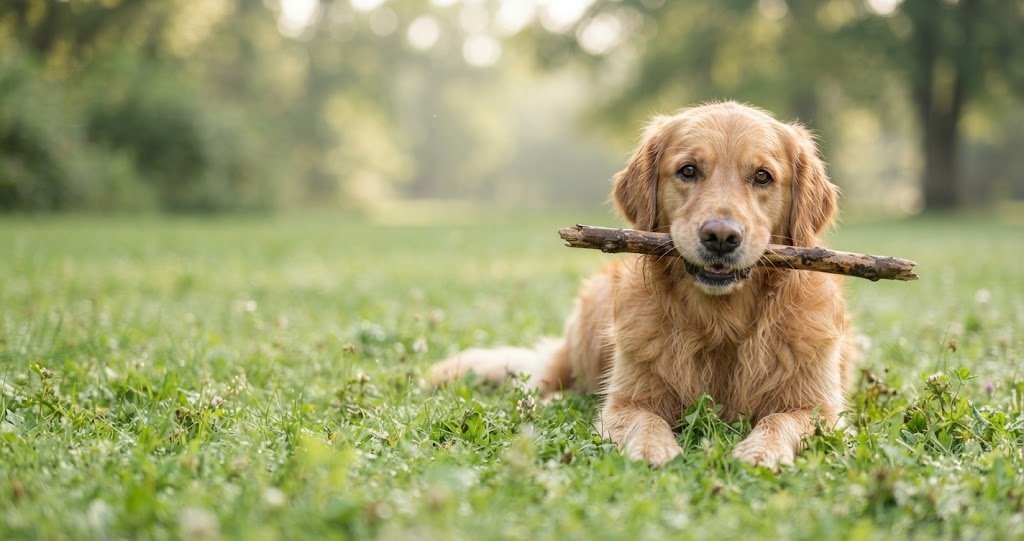
Carrying a stick is different from chewing and swallowing one. BetterPet notes that carrying is often fine, but ingesting sticks can cause oral injuries, obstruction or poisoning.
Why sticks are risky: they can splinter, choke or block the bowel, and some come from toxic plants (Rover). Stuck pieces can cause oral infections, and oral injuries often end up in the emergency room (Great Pet Care). Sticks can also carry mold, and swallowed pieces won’t be digested (PetsRadar). Black cherry, red maple and walnut wood can be poisonous (BetterPet). If your dog swallows pieces and then vomits, has diarrhea or won’t eat, call your vet (Miami Pet Concierge).
What to do instead: when your dog starts hunting for sticks, offer a proper chew at that moment. A bully stick is a digestible alternative that gives the same gnawing outlet. If the behavior is constant or compulsive, see your vet about pica or dental pain.
Are bully sticks safe for dogs?
For most dogs, yes, when they come from a reputable maker, fit the dog’s size, and are supervised. They aren’t risk-free.
- Calories. An average 6-inch stick is about 88 calories: roughly 9% of a 50-pound dog’s daily needs, but 30% of a 10-pound dog’s (Tufts University). A commonly cited guideline keeps treats to about 10% of daily calories (also noted by Jack’s Premium).
- Bacteria. In the 2013 study, one stick contained C. difficile, one MRSA and seven E. coli (Fox News). That’s a small, older sample, so it’s a reason to buy from tested makers, not to panic.
- Handling. The FDA says Salmonella can contaminate pet treats, so wash your hands after handling them. The CDC gives the same advice and adds to pick up treats when your pet is finished.
- Choking. Take the stick away when it’s small enough to swallow, around 2-3 inches according to Jack’s Premium. A bully stick holder helps.
- Allergies. Beef is an allergen for some dogs, so skip bully sticks if yours has a known beef sensitivity.
- Puppies. Chewy says puppies can have them once they can chew hard food and treats, starting with thin sticks. They aren’t suitable as training treats because they take too long to eat.
Storage: keep sticks in a cool, dry place, ideally in an airtight container. Brands quote shelf lives of about two to three years, so check the pack. Discard any stick that looks moldy.
This is general information, not veterinary advice. Ask your vet if your dog has a medical condition, is overweight or is on a restricted diet.
How to choose a good bully stick
- One ingredient. The label should say beef pizzle or bull pizzle only.
- Clear sourcing. Reputable brands tell you the country of origin and how the cattle were raised.
- Testing. Look for batch testing or independent lab results.
- The right size. Jack’s Premium suggests thin 6-inch sticks under 25 pounds, standard sticks for 25-50 pounds, and thick or jumbo above 50 pounds. Treat that as a starting point, not a rule.
- Appearance and smell. A good stick is a consistent tan to brown with no mold. It should smell beefy, not rotten.
A non-beef alternative: yak chews
Some households skip bully sticks because of the smell, a beef sensitivity, or just to rotate chews. Yak Dog Chew’s Himalayan chews are made from yak milk, cow milk, lime juice and salt. The brand describes them as hard, long-lasting and suitable for dogs 6 months and older, and adds that they should be supervised and aren’t recommended for aggressive chewers or dogs with dental issues. Because they’re very hard, check with your vet first if your dog has fragile teeth.
Explore: Yak Dog Chew’s Himalayan dog chews
FAQ
What are bully sticks made of?
Bully sticks are made of beef pizzle, the muscle of a bull’s or steer’s penis. It’s cleaned and dried or baked into a chew. A good stick has one ingredient and no fillers.
What are bully sticks made of for dogs, and is it real meat?
Yes, it’s real beef muscle, though not a typical cut like steak. Because it’s muscle rather than bone or hide, the AKC says it breaks down more easily than rawhide.
What are bully sticks for dogs made of if they’re odor-free ?
The same beef pizzle. Odor-free sticks are usually washed more and dried longer. Check the label for any added ingredients.
Are bully sticks made from bones?
No. They contain no bone. They’re a single muscle and don’t splinter the way bones can.
Why do dogs eat sticks?
Mostly because chewing is natural and sticks smell and feel interesting. Boredom, teething, anxiety, dental pain or pica can also play a part. A safe chew gives them a better outlet.
How many bully sticks can my dog have?
It depends on size and diet. Each stick adds calories, so count it as part of the daily treat allowance and ask your vet for a number that fits your dog.
Why are bully sticks so expensive?
Each bull has only one pizzle, the sticks are trimmed by hand and take two to three days to dehydrate, and demand is high.
Final thoughts
So, what are bully sticks made of? One thing: beef pizzle, dried into a chew. What really matters is where it’s sourced and how it’s processed, so read the label and buy from brands that explain themselves. Supervise your dog, count the calories, and when you catch them dragging a stick in from the yard, swap it for a chew made for the job. Next step: compare the ingredient list on your current chew with the checklist above