Are Yak Chews Good for Dogs?
Yes, yak chews are a good long-lasting chew for most healthy adult dogs, because the hard, digestible cheese scrapes soft plaque off the teeth while keeping a dog busy. They do not remove tartar that has already formed, and their hardness means the wrong dog or the wrong size can end with a cracked tooth.
For centuries, herding communities in Nepal, Tibet and Bhutan made a hard cheese called chhurpi so that milk would keep without refrigeration. The recipe reached dogs much later, and the cheese sold today as a yak chew follows the same method, with no preservatives added.
That short ingredient list has a practical side. A yak chew is naturally grain-free and gluten-free, which suits dogs on limited-ingredient diets. It is not a miracle product, though. It supports a good dental routine rather than replacing one, and the sections below show where it helps, where it falls short and which dogs should skip it. In practice, the biggest variable is rarely the cheese: a steady gnawer and a hard cruncher can get very different results from the same chew.
What Exactly Is a Yak Chew?
A yak chew is a very dense bar of hard Himalayan cheese made from yak milk and cow milk, pressed, dried and then smoke-cured for several weeks. The same product is sold as a Himalayan chew, yak cheese chew or Himalayan dog chew, so those names point to one thing rather than four.
The curing leaves a low-moisture block that a dog can gnaw for a long time without it crumbling. You may spot dark flecks on the surface. That is smoke residue from drying, not mold, and it is harmless.
Owners also get a chew with a low odor, which is part of why many keep one around the house. Unlike cooked bones, a yak chew does not splinter, though its density is exactly why it needs careful picking, as the safety section explains.
What Are Yak Chews Made Of?
Yak chews are made from yak milk, cow milk and lime juice, and the traditional recipe adds nothing artificial. Some products add no salt while others include a little, so the label of the specific product is the thing to read.
The milk is boiled, the fat is skimmed off, and lime juice curdles what is left so the solids separate from the liquid, which carries away most of the lactose. Those solids are wrapped in cloth, pressed under a weight, shaped and dried slowly over smoke.
That is the whole list. It contains no artificial binders, no starchy fillers and no added sugar, so the firmness comes from pressed milk solids alone.
Is Yak Cheese Good for Dogs?
Yak cheese is a high-protein chew with very little lactose, not a complete food. Peer-reviewed analyses of hard yak cheese put protein at 53 to 69 grams per 100 grams, depending on milk source and processing, while some product claims go as high as 85%, a figure above what lab analyses actually measure.
The low lactose comes from production. Boiling the milk and removing butterfat leaves a high-protein, low-fat base, the lime juice then works as a coagulant, and most lactose leaves with the whey. A finished chew typically holds under 2 grams of lactose per 100 grams, which is why most dogs with sensitive stomachs tolerate it.
Low lactose does not mean dairy-free, though. A dog with a true allergy to milk protein should avoid yak chews entirely, and owners of dogs on low-lactose diets should check with a vet first. The cheese began as human food that was dense in protein and shelf-stable for years.
Are Yak Chews Safe for Dogs?
Yak chews are safe for most healthy adult dogs, and the real risk is a cracked tooth rather than a stomach problem. Pieces that break off soften and digest like food, and the American Kennel Club notes that yak cheese chews are digestible and do not splinter the way cooked bones can. Rawhide is poorly digestible and can expand in the stomach or intestines, causing an obstruction that sometimes needs surgery, and hard nylon passes through intact. That puts the choking risk and obstruction risk of a yak chew well below those options, as long as a dog is not gulping large chunks.
Hardness is the honest caveat. Veterinary dental specialists list yak chews alongside bones and other very hard chews that can fracture teeth. Tufts University’s Cummings School of Veterinary Medicine offers a thumbnail test: if you cannot press a thumbnail into the chew and leave a dent, it is too hard, and a fresh yak chew fails. Cornell’s Riney Canine Health Center and the American Animal Hospital Association give the same advice, and a dog with worn enamel deserves extra caution.
In practice, the controllable parts are size, sessions and attention. Begin with sessions of 10 to 15 minutes, watch how the dog gnaws, and remove small pieces or the nub once it shrinks. A dog that gnaws steadily is at lower risk than one that bites hard and fast.
Which Dogs Should Skip Yak Chews?
Yak chews are a poor fit for puppies under six months, seniors with weak teeth, hard crunchers and dogs with a true dairy allergy. The table shows the reason for each group and what to do instead.
| Dog | Why a yak chew is a poor fit | What to do instead |
|---|---|---|
| Puppy under six months | Developing teeth are not strong enough for this hardness | Wait until adult teeth are fully in |
| Senior with dental disease or weakened teeth | Older teeth fracture more easily | Choose a softer chew |
| Hard cruncher, including serious chewers | Biting hard raises fracture risk | Choose a softer chew |
| Dog with a true dairy allergy | Low lactose is not the same as dairy-free | Avoid yak chews entirely |
A dog that already crunches through antlers will probably treat a yak chew the same way, so judge by chewing style rather than breed or size. Yak chews are sometimes marketed for aggressive chewers, but the veterinary guidance above points the other way.
A dog with a lactose-sensitive stomach is a milder case, because so little lactose remains that most cope. Still, start slowly and watch for diarrhea over the first few sessions.
What Is the Difference Between Plaque and Tartar in Dogs?
Plaque is a soft, sticky film that forms within hours of eating, while tartar is hardened plaque that sets after a few days. Only plaque can be handled at home. The two behave very differently:
| Plaque | Tartar | |
|---|---|---|
| Consistency | Soft, sticky film | Hard, mineral deposit |
| How fast it forms | Within hours of eating | After a few days, as minerals in saliva harden the film |
| What removes it | Brushing, chewing and some help from saliva | A vet’s dental cleaning only |
Minerals in saliva, calcium among them, latch onto the film and turn it into a shell that is practically part of the tooth surface. After that, neither brushing nor chewing shifts it.
That timeline is why regular chewing counts for more than one marathon session. A chew that interrupts plaque every few days keeps it from ever reaching the hardening stage.
How Does Chewing Clean a Dog’s Teeth?
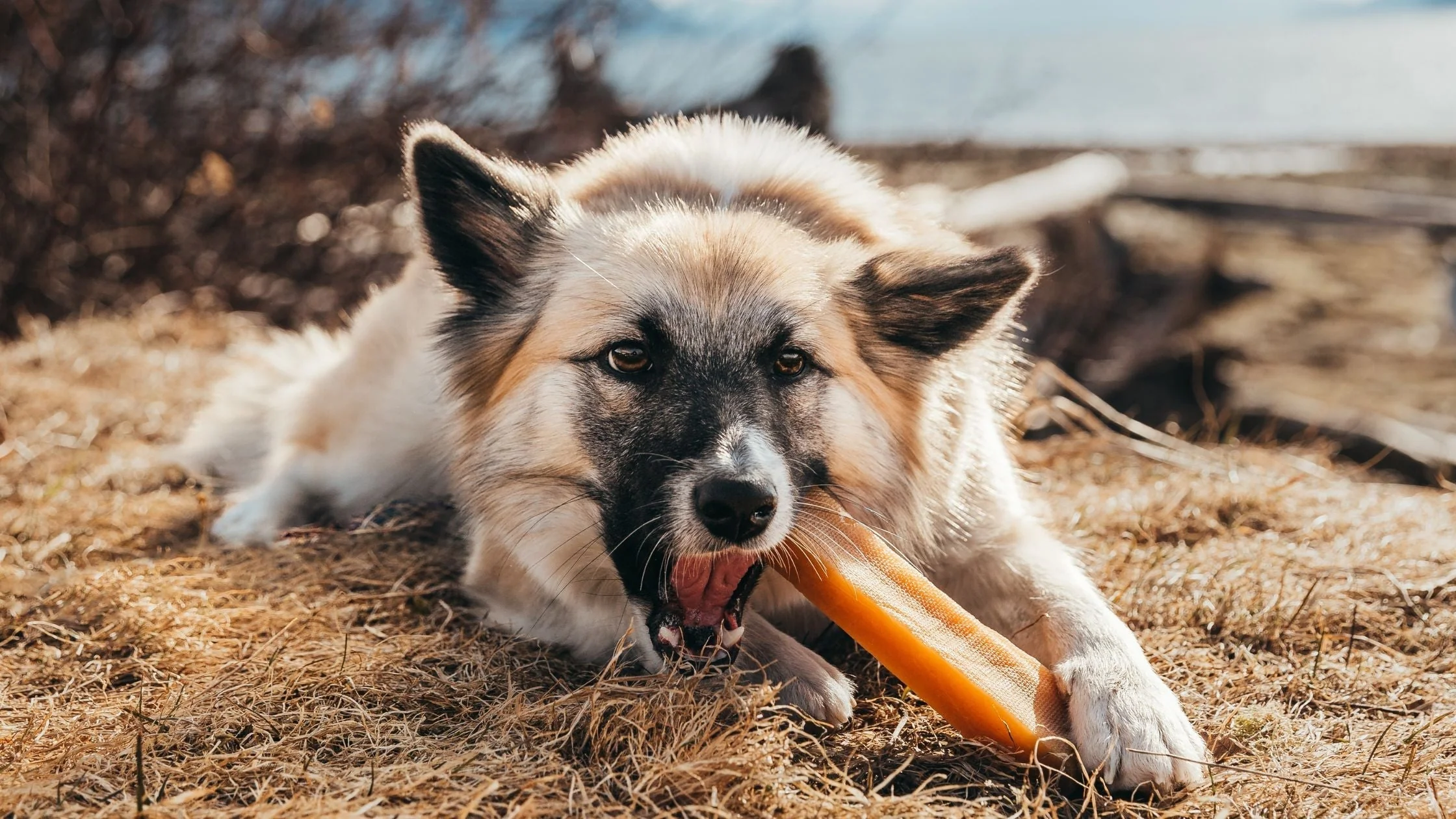
Chewing cleans teeth through friction: a firm chew rubs against the tooth surface and scrapes off plaque before it can harden, and the effort gets saliva flowing, which brings natural enzymes that help fight oral germs. A soft treat is gone in seconds with almost no scraping, so the length of the session matters as much as the chew itself.
A yak chew stretches that session. The scrubbing action carries on while the dog works the chew, and the surface turns slightly rough and fibrous, which adds a little more friction. A typical session lasts about 20 to 40 minutes, though how long the whole chew survives depends on the dog. Most dental sticks vanish far sooner, which leaves less time for scraping.
The habit has side benefits too. A dog with something proper to chew is less likely to go after the couch, and a yak chew leaves no smell on the cushions. Dogs also find the cheese appealing, so they come back to it without the resistance many show toward brushing.
Can a Yak Chew Remove Tartar That’s Already There?
No, a yak chew cannot remove tartar that has already formed, because tartar, also called calculus, is mineralized and bonded to the tooth. It is no longer food debris sitting on the surface, so no amount of gnawing, whether on a yak chew or the hardest chew on the market, will break down that shell.
If a dog already has a visible deposit near the gums, the answer is a professional cleaning at the vet, performed with the dog asleep so the vet can scale below the gums safely. Chewing still has a job afterward, because it slows new buildup and helps keep a freshly cleaned mouth that way.
Book annual vet dental checks so you know whether the routine is working, since a chew cannot judge that for you.
How Do You Get the Most Dental Benefit From a Yak Chew?
You get the most from a yak chew by offering it often, matching its hardness to the dog and pairing it with brushing. Offering one only now and then does little, and several sessions each week is where results begin. Some suggest daily use, but a very hard chew every single day also adds to fracture risk, so build up gradually.
Hardness needs balance. Too soft and the chew is gone before it does any work, and too hard and the dog may crack a tooth. A chew with a firm texture only works if the dog gnaws steadily rather than biting hard. Watch which side of the mouth your dog favors, since that side gets more cleaning, and change how you hand over the chew to even things out. Chewing is also a self-regulating habit that eases stress and keeps a dog calm, which makes the routine easy to maintain.
Check progress with a finger. Every couple of weeks, run it along the back teeth: smooth means things are going well, while a gritty feel near the gumline means plaque is winning. A yellow or brown crust there needs a vet, not a longer chewing session. Brushing remains part of the plan because it reaches the inside surfaces that a chew can miss.
What Size Yak Chew Should You Buy?
Choose the size by dog weight: small chews suit dogs up to around 15 to 20 pounds, medium chews suit 20 to 40 pounds, large chews fit 40 to 70 pounds, and extra large or mega chews are made for bigger dogs and heavy chewers. A dog on the boundary between two sizes should go up rather than down.
Too small is the worse error. A chew that is too small can be gulped down before it has been worked properly, while one that is too large is not necessarily dangerous but feels unwieldy for a smaller dog.
Size also affects how long a chew keeps a dog occupied. Yak chews generally last longer than bully sticks or most edible treats, though results vary with the dog’s size and chewing style. Treat the chew as an activity rather than a meal replacement, and keep an eye on portions, because overconsumption is the usual cause of an upset stomach.
What Should You Do With the Last Piece of a Yak Chew?
Turn the last piece of a yak chew into a puffed treat, because a nub small enough to be swallowed whole is a choking hazard. After days to weeks of gnawing, every yak chew ends in a short nub that is too small to chew safely but too good to throw away.
- Soak the nub in water for a few minutes to soften the outside.
- Place it on a microwave-safe plate.
- Microwave on high for 30 to 60 seconds, watching closely.
- Let the puffed nub cool completely before handing it over.
Treat the microwave step as a job that needs supervision, since microwaves vary. The result is a light, airy, crunchy piece that is fully edible and digestible, and most dogs finish it in about thirty seconds.
Do Yak Chews Actually Clean Dogs’ Teeth?
Yes, yak chews help clean dogs’ teeth by removing soft plaque through the mechanical action of gnawing, and the longer a dog chews, the more plaque is scraped away. Think of the benefit as prevention rather than correction, because a chew can stop plaque from setting but cannot undo tartar. The saliva that chewing stimulates also adds natural enzymes that help fight oral germs.
Can Yak Chews Remove Tartar Once It’s Formed?
No, yak chews cannot remove tartar once it has formed, because tartar sits far harder on the tooth than soft debris does. Picture scraping dried cement off a sidewalk with a fingernail: loose material comes off, but the set layer does not move. Removal needs a vet cleaning, usually done under anesthesia so the vet can scale below the gums safely.
How Often Should I Give My Dog a Yak Chew for Dental Benefits?
A few times a week works for most dogs, while one chew a month does little for the teeth. Some suggest a daily session of 20 to 30 minutes, but because yak chews are very hard, starting lower and watching the dog’s teeth is the safer path. Consistency matters more than the length of any single session.
Are Yak Chews Better Than Other Dental Chews?
Yak chews are not proven better than other dental chews. They work on the same principle and give a dog more chewing time, but no yak chew holds a VOHC seal from the Veterinary Oral Health Council, the standard for clinically proven dental efficacy. Much of the reputation comes from word of mouth, since groomers recommend them and owners swap tips online.
Can Yak Chews Replace Brushing My Dog’s Teeth?
No, yak chews cannot replace brushing, and they work best as a supplement to it. A chew cannot reach every tooth surface the way a toothbrush does, so even weekly brushing with dog-safe toothpaste adds real protection on top of the chews. Dogs that get both tend to have the cleanest teeth.
Can Yak Chews Upset a Dog’s Stomach?
Yak chews can cause loose stools in some dogs, usually when a dog eats too much. A dog new to them may show digestive upset in the first few sessions, so offer short sessions and keep fresh water available.
Are Cranberry Yak Chews Better for Dental Health Than Plain Ones?
Cranberry yak chews are not proven better than plain ones, because the supporting evidence comes from human dental health and research in dogs is still developing. Cranberry compounds may stop harmful bacteria from adhering to teeth and gum tissue, which is a sensible idea but an unproven one in dogs. The practical benefit is flavor: a dog that likes its chew uses it more consistently, and flavors such as blueberry, strawberry and mint are available for dogs that need extra encouragement.
Are Yak Chews Safe for All Dogs?
No, yak chews are safe for most healthy adult dogs but not for all of them. Puppy cutoffs are sometimes given as four months, but waiting until adult teeth are fully in, at six months, is the cautious choice. Seniors with loose teeth should skip them. On the plus side, boiling the milk pasteurizes it, and digestible pieces carry less risk of blockages than rawhide, though a large chunk can still cause trouble.