
Yak Chews vs Bully Sticks: Which Is Better for Your Dog?
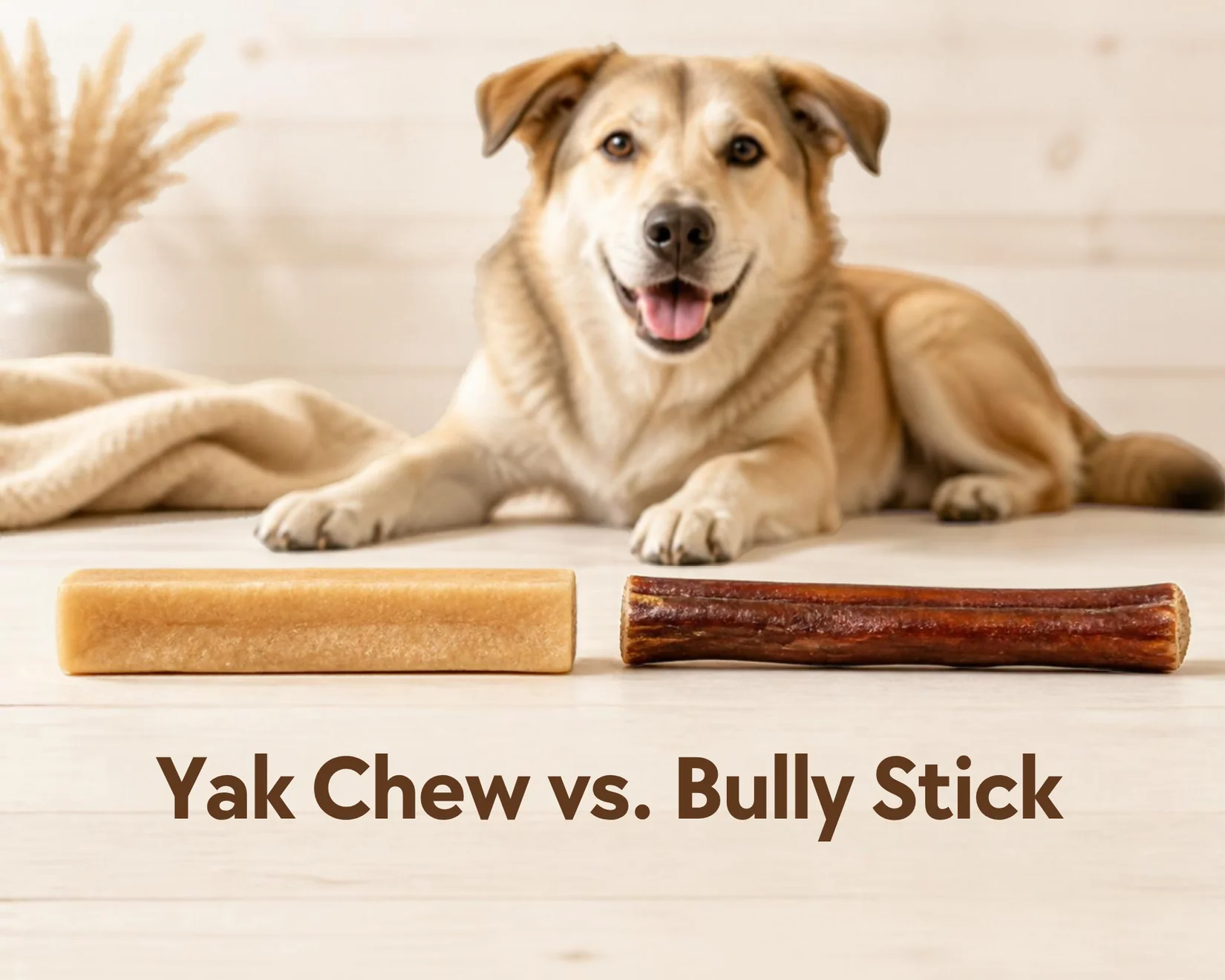
A yak chew is a hard cheese chew from the Himalayan region that dogs gnaw down slowly, while a bully stick is a dried beef treat with a single ingredient that many dogs finish in one sitting. The better pick depends on whether your dog handles dairy, how closely you count calories, and how tough a chew its teeth can take.
Bully sticks are cut from the pizzle of a bull or steer and dried into a firm stick, whereas yak chews are dairy-based. Both are rich in protein, and one guide credits both with supporting oral health through the chewing action.
Neither one is rawhide, which is part of why owners reach for them first. In practice, the useful question is which chew fits this particular dog, and if yours has dental trouble or a touchy gut, ask a veterinarian before buying either.
What Are Yak Chews Actually Made Of?
A yak chew is a dense, dairy-based chew made from the milk of yaks and cows, and it works as a non-meat option for dogs.
The finished chew is hard and bumpy, with a slight odor that one retailer describes as pleasant and noticeable only when the chew is held up under your nose. Another guide goes further and calls yak chews virtually odorless.
On nutrition, one nutrient list includes calcium, zinc, iron and vitamin A for yak chews. Calcium supports bones, and iron is needed for red blood cells that carry oxygen through the body.
The recipe is clean by design. Two guides say these chews are free of synthetic color and added chemicals, and one lists low salt content among their benefits. A third guide adds that yak chews are easily digestible, with less gastrointestinal risk than bully sticks.
What Is a Bully Stick Made From?
A bully stick is a dried beef chew, and the best ones contain no artificial colors or other extras.
Hard at first, the stick will soften and turn mushy as a dog chews it, yet it stays pliable enough to be chewed down rather than crunched, according to one guide. A thin profile also separates it from the blocky yak chew.
Because it is an animal product, a bully stick carries a strong smell that some owners tolerate and others do not.
One comparison guide lists the nutrients that bully sticks provide:
- Phosphorus: supports bone health and cell function.
- Chondroitin and glucosamine: linked to joint health, with the guide saying they can reduce the risk of arthritis in dogs.
- Magnesium: helps maintain healthy muscles and nerve function.
- Vitamin B12: supports nervous system function.
What Are the Pros and Cons of Each Chew?
The pros and cons come down to durability versus hardness: yak chews outlast bully sticks but can be tougher on a dog’s mouth.
One retailer backed the durability point with its own informal experiment, repeated across three tests with similar results each time. Here is how its 12-inch bully stick compared with a yak chew:
| Dog | 12-inch bully stick | Yak chew |
|---|---|---|
| Pitbull | 20-25 minutes of continuous chewing | Several hours of continuous chewing over several days |
| Australian Shepherd | 30 minutes of continuous chewing | Several hours of continuous chewing over several days |
That retailer says the yak chew outlasted the bully stick by days to even a week. Treat that as one retailer’s observation rather than lab data.
On the downside, yak chews can be too hard for dogs with weaker teeth, and another guide notes that any tough chew carries a choking hazard for dogs that bite off oversized chunks. Bully sticks bring extra cleaning when they get wet, and their odor can be off-putting to some households.
Which Chew Is More Nutritious?
Neither chew is clearly more nutritious: both offer strong nutritional value, and the better fit depends on a dog’s nutritional requirements.
One guide could not quantify the gap between them and awarded both chews a point. In broad terms, yak chews lean toward bone-building minerals, while bully sticks lean toward joint-support compounds.
Sourcing matters as well. Another guide says top-quality bully sticks come from grass-fed, free-range cattle, and it credits them with improving skin, coat, brain and muscle.
Weight is another lever. That guide says yak chews can help an undernourished dog keep a healthy weight, and that both chews can help a malnourished or underweight dog recover.
Variety extends the benefits too. A retailer says yak cheese can be blended with turmeric, carrot, blueberry, strawberry or coconut for extra benefits.
How Many Calories Are in Each Chew?
Sources disagree on which chew carries the lower calorie content, and the only independent measurement covers bully sticks alone.
That measurement comes from a study by Tufts University’s Cummings School of Veterinary Medicine and the University of Guelph, led by Dr. Lisa Freeman and published in the Canadian Veterinary Journal in January 2013. The team tested 26 bully sticks from different manufacturers, and that study did not measure yak chews at all.
One guide argues bully sticks hold fewer calories than yak chews, which is why it recommends them for big, heavy dogs. A second guide calls bully sticks calorie-dense, and a third says they carry more fat, so readers get conflicting guidance.
Size and breed shape the math. Breeds with easy weight gain need extra care, since a calorie-rich chew can tip the balance for a small, inactive dog.
Do Bully Sticks Carry Bacteria?
Yes, an academic laboratory study of bully sticks found harmful bacteria in a minority of the samples.
The guide that reported it stresses that this is one study of a limited sample taken more than a decade ago, not a current guarantee about any brand’s manufacturing process. Even so, it undercuts the misconception that a natural chew is automatically sterile.
Buying from trustworthy pet supply stores improves your odds of getting a cleanly made product, and it helps to monitor how your dog carries a stick around the house.
The concern is sharpest in homes with a weakened immune system. That guide advises keeping vulnerable household members from handling dried animal-protein treats directly.
Which Chew Lasts Longer?
A yak chew generally lasts longer than a bully stick, because a yak chew is gnawed down slowly while many bully sticks are fully eaten in one sitting.
The slow pace begins in manufacturing. One guide says the milk mixture is boiled, then dried into a hard, durable chew.
A long-lasting chew also does behavioral work. It supplies mental stimulation, eases boredom, and can curb destructive behavior such as chewed shoes, upholstery and pillows, as another guide points out.
Duration shifts the cost per chew too. One guide calls both options relatively pricey, but the chew that lasts longer stretches further. Another cautions that no chew carries a fixed time promise, because dogs, chew size and how hard each dog chews all vary.
Is a Yak Chew Too Hard for Your Dog’s Teeth?
A yak chew is a hard chew that can be too tough for dogs with fragile teeth, while a bully stick is gentler.
Hardness starts with processing. Yak chews are cured and dried, and one retailer says its chews are dried for about a month. Bully sticks are hung to dry and stretched, which leaves them hard at first and softer after long chewing.
Both chews can reduce plaque and tartar, and one guide says a yak chew’s firmer surface may clean more thoroughly. A third guide meanwhile lists tooth decay among the problems caused by harmful ingredients in cheaper treats.
Aggressive chewers and older dogs deserve the most caution. A dog that crushes hard objects risks cracked teeth, and the retailer warns that a small chunk can break off and become a hazard.
If a dog ignores a dry chew, one guide says online owner communities suggest soaking it in water, and a retailer’s preparation tip uses a soak for 30 seconds before heating a small end piece.
Which Chew Smells Worse and Makes More Mess?
A bully stick smells stronger than a yak chew, so yak chews are the cleaner option for the home.
Processing explains much of the difference. A bully stick is harvested and dried, while a yak chew is smoked, which leaves only a faint cheese scent.
A pet parent bothered by the smell might shop for odor free bully sticks, but one retailer warns that such sticks may contain formaldehyde or bleach to mask the natural scent.
That retailer adds that odorless versions may include preservatives or other additives to control odor, and it gives yak chews the point on that round because no odorless yak version exists. Another guide, however, describes yak chews as having little to no odor. As for mess, the retailer says both chews are hard enough to shed few pieces, whereas a third guide notes bully sticks get wet as the dog chews.
Which Chew Is Easier on Digestion and Safer Against Choking?
Neither chew is risk-free, but yak chews are rated gentler on digestion while bully sticks are rated safer against choking.
One guide says yak chews are easily digestible, whereas bully sticks may cause digestive upset when a dog eats them too fast, and overconsumption makes it worse.
Another guide reports no history of allergies triggered by yak chews, notes that the chews contain minimal milk, and says dogs don’t typically show lactose intolerance.
Choking depends on size. That guide calls bully sticks totally safe for puppies when the treat size suits the dog, and warns that big dogs given a small stick may gulp it. Bully sticks come in thin, regular or thick versions, and the available sizes run from 6 to 12 inches, sometimes longer, per a retailer.
What Variety and Price Differences Should You Expect?
Yak chews come in a wider range of varieties than bully sticks, and both carry a relatively expensive price tag, according to one guide.
A retailer says bully sticks stay fairly basic, while yak chews arrive in a wide flavor range. For new pet owners, that variety can feel overwhelming. Another guide notes there are more than a hundred chew options on the market, so narrowing by a dog’s preference is a practical start.
Production differs too. The retailer says its yak chews are handmade in Nepal from a traditional recipe, while the other guide says top bully sticks come from cattle raised across South America and North America.
Both products widen a dog’s treat repertoire, and a chew suits special occasions and works as a gesture of affection. Letting a dog try both is the surest way to learn which one it prefers.
Why Give Your Dog a Chew at All?
A natural chew gives a dog a satisfying snack that fills its time and tops up its nutrition.
One guide says these treats supply the energy a dog needs for daily activities, and young dogs in particular enjoy gnawing on a tricky chew.
A chew can also calm restlessness. A dog that finds the flavors irresistible will stay busy for hours, and a retailer says a yak chew keeps a dog occupied for hours on end.
Even a leftover stub finds a second life when a small end piece goes through the microwave and turns into popped yak cheese, which the retailer compares to crunchy yak popcorn.
How Do You Pick Between a Yak Chew and a Bully Stick?
Choose a yak chew for a dog that handles dairy and chews slowly, and choose a bully stick for a dog that needs a softer, dairy-free treat.
The debate has no universal winner, and that dilemma is why one guide frames its comparison around how a dog handles dairy, how closely calories are tracked and how hard a chew the teeth can manage. It describes a bully stick as dried beef muscle and a yak chew as a dairy chew.
| Dog’s situation | Better fit | Reason |
|---|---|---|
| Dairy sensitivity | Bully stick | Contains no dairy, though a vet should still be asked first |
| Closely tracking calories | Depends | Bully stick calories vary by length; check packaging for yak chews |
| Dental problems or hard crushing | Ask your vet first | Cracked-tooth risk from hard chews |
| Wants a quick treat | Bully stick | Many dogs finish it fast |
| Wants a slow session | Yak chew | Designed to be gnawed under supervision |
For sensitive stomachs, one guide favors yak chews, while a retailer notes a bully stick breaks down in stomach acid if gulped by accident.
A dog prone to obesity needs calorie checks, so count either chew among daily treats. The retailer says yak chews are generally lower in fat than many meat-based chews.
For training, either chew supports positive reinforcement. One retailer offers bully sticks stuffed with super greens or cranberry, plus a bundle for sampling several.
How Do You Match a Chew to Your Dog’s Size?
Choose a chew whose length and thickness suit your dog’s body weight and chewing power, and start with a gradual introduction instead of handing over a full chew on day one.
During the first sessions, watch for gagging or drooling, which can suggest the chew is too large or the dog is struggling with it. This is general practice guidance rather than a sourced fact, so your vet has the final word.
Count the portion against your dog’s daily food, since the bully stick calorie study showed that one stick can be a big share of a small dog’s day. A regular weigh-in shows whether chews are quietly adding weight, and offering a variety of lengths and thicknesses lets you learn which one your dog handles best.
How Should You Store Yak Chews and Bully Sticks?
Store both chews sealed, dry and away from heat, because damp and warmth are what spoil dried animal-based treats.
Match what you buy to the dog. Toy breeds and small breeds need short, slim chews, while large breeds need a greater chew diameter, so buying one oversized pack for a small dog wastes money and stock.
A simple chew rotation keeps older stock at the front of the shelf, and a treat budget helps you buy only what your dog will finish before the chews sit around too long.
Can Dogs With Fat-Related Digestive Problems Have These Chews?
A dog with a fat-related digestive illness should have a chew only after a vet approves it, because sources disagree on how much fat each chew carries.
One guide says bully sticks carry more fat than yak chews, while another says the opposite, so neither can be assumed safe. Ask your vet to match any chew to your dog’s weight class and feeding schedule.
Signs that a fatty treat is not agreeing with a dog include vomiting, diarrhea and lethargy, and persistent symptoms call for an emergency vet. This is general guidance, not a sourced claim.
Which Warning Signs Mean You Should Take the Chew Away?
Take the chew away at once if your dog chokes, shows signs of tooth damage, or the chew looks spoiled.
Throw out any chew showing mold or unusual moisture, and retire one that has shrunk below your dog’s jaw size, since a small stub is the piece most likely to be gulped.
Fat-sensitive dogs, dogs on a prescription diet, and any dog with a history of pancreatitis should not get chews without veterinary advice. Calling your vet early costs less than treating a flare-up later.
How Often Should You Give a Chew?
Offer a chew occasionally rather than daily unless your vet says otherwise, because both chews count toward your dog’s calories.
If your dog is on a low-fat diet or has a medical history of digestive trouble, ask your vet how often a chew fits in.
Save leftovers for the next session in an airtight container or resealable bag, kept in a cool dry place, and check the shelf life printed on the packaging before reusing an opened chew.



One Response