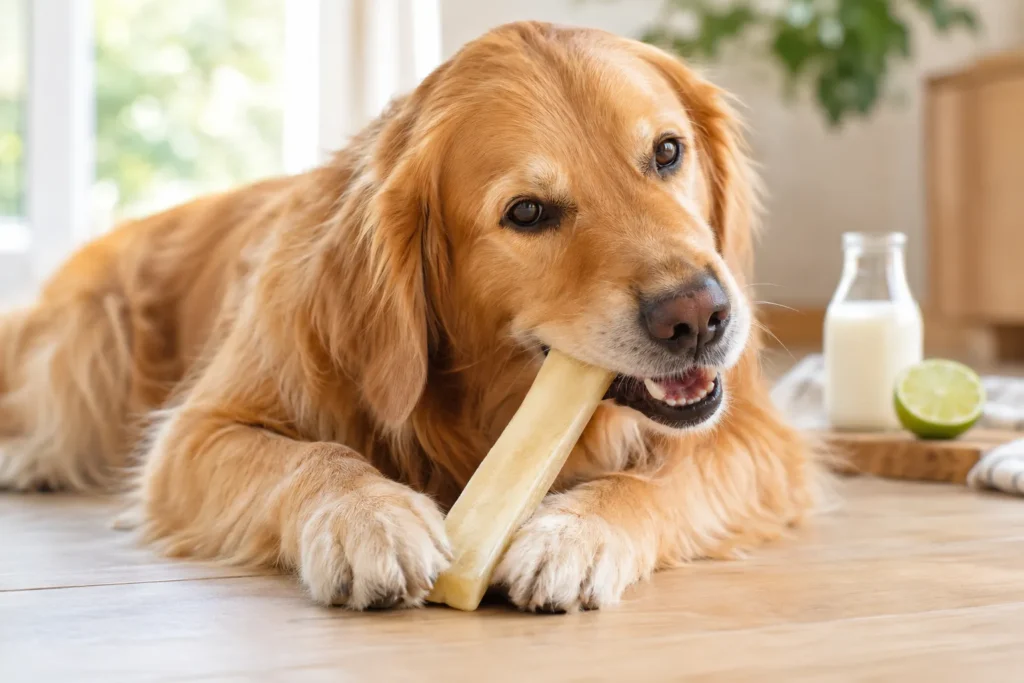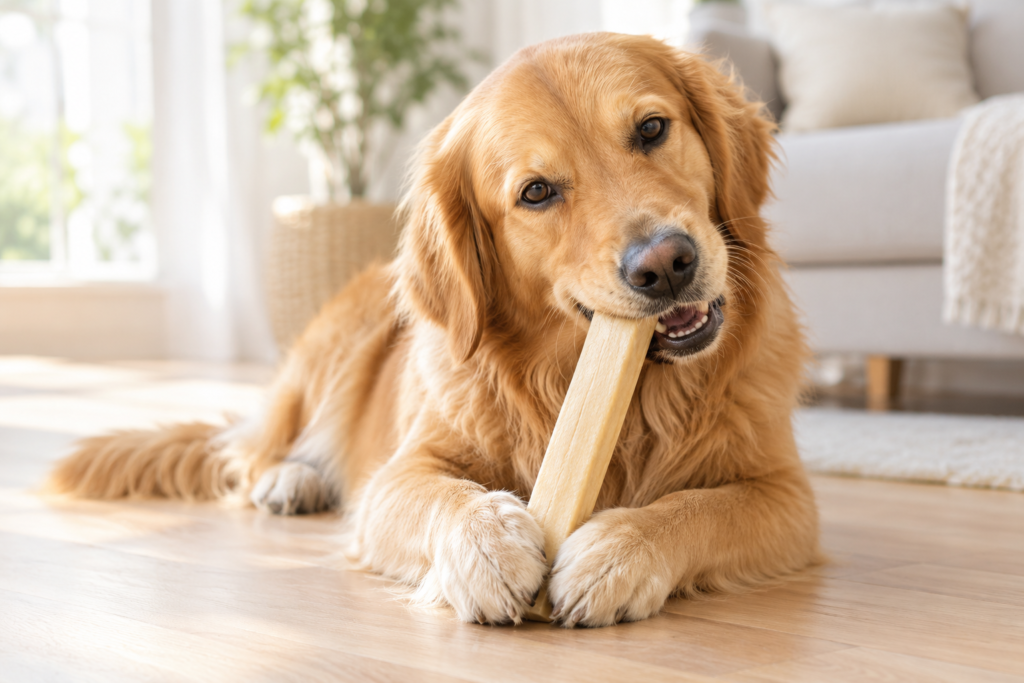
Yak chews are safe for most healthy adult dogs when you choose the correct size and stay in the room while your dog chews. The real risks are narrow and specific: a hard, direct bite can crack a tooth, and a chew that wears down to a small “nub” can be swallowed and become a choking or blockage risk. Yak chews are not automatically appropriate for puppies under 6 months, senior dogs with existing dental disease, or dogs that chew with a hard, direct bite rather than gnawing.
That’s the short version. If you want the full picture, including what vets actually disagree about, how yak chews compare to rawhide, bully sticks, antlers, and bones, and a step-by-step way to introduce one safely, keep reading. This guide runs long on purpose, because “is it safe” is really five smaller questions, and each one deserves a real answer instead of a marketing line.
We put this guide together as the team behind Yaksy Dog Chews, because we’d rather an owner read the honest, complete picture here than buy a chew from us (or anyone else) without understanding what to watch for.
1. What Exactly Is a Yak Chew?
A yak chew, also marketed as a Himalayan chew, yak cheese chew, or Himalayan dog chew, is a dried, hardened block made primarily from yak milk, often blended with cow’s milk, and set with a small amount of lime juice and salt. The mixture starts as a soft curd, gets pressed into a mold, and is then air-dried or lightly smoked over several weeks until nearly all the moisture is gone. What’s left is a dense, cheese-based block that’s closer to a mineral in hardness than to anything most people would call “cheese.”
The product dogs chew on today is, almost without modification, a human food that has existed in the Himalayan region for centuries. Dogs simply inherited it, the way dogs tend to inherit whatever their owners are already eating or making.
2. Where Yak Chews Come From: A Short History of Chhurpi
The human version of this cheese is called chhurpi (also spelled churpi or chhurpi, and known as durkha in Bhutan). According to food historians and Himalayan anthropologists, chhurpi was developed out of necessity: herding families in Nepal, Bhutan, Tibet, and parts of India produced more milk than they could sell or drink fresh, particularly from yaks and dzo (a yak-cattle hybrid), and needed a way to preserve it without refrigeration.
The traditional process is simple but slow. Milk, usually a mix of skimmed and whole milk, is heated and curdled with a natural acid or fermented milk starter. The curds are strained, pressed into wooden molds using stone weights for roughly 24 hours, and then dried, either by hanging over a wood fire, smoking, or air-drying in the thin mountain air for weeks or months. The result is a cheese with extremely low moisture content, which is precisely why it becomes so hard, and precisely why it can be stored for months or years without spoiling.
Traditionally, chhurpi wasn’t a novelty snack. It was survival food. Herders carried it on long treks because it didn’t need refrigeration and provided a dense, portable source of protein and calcium. Locals describe eating it the way you might work through a piece of hard candy or gum, one small piece dissolving in the mouth over the better part of an hour. Some pieces required overnight soaking just to become soft enough to eat.
Dogs in Himalayan households ate the same cheese their owners did, largely because it was available, cheap relative to meat, and durable enough to survive being handled by an animal. Western pet brands began importing and marketing the product specifically as a dog chew in the 2000s and 2010s, branding it as “yak chew,” “Himalayan dog chew,” or “yak cheese chew,” and it has since become a mainstream alternative to rawhide.
Understanding this history matters for one practical reason: chhurpi was never engineered with a dog’s teeth in mind. Its hardness is a side effect of a preservation method designed for humans and long journeys, not a feature calibrated for canine dental safety. That’s not a criticism of the product, it’s context for why hardness deserves your attention as an owner.
3. How Yak Chews Are Made
Modern commercial yak chews follow roughly the same process as traditional chhurpi, scaled up for consistency:
- Sourcing the milk. Yak milk, often blended with cow’s milk to standardize supply and cost, is collected from herds in the Himalayan foothills, most commonly in Nepal.
- Curdling. A small amount of lime juice (or another natural acid) is added to coagulate the milk into curds. Salt is added at this stage too, both for flavor and as a natural preservative.
- Pressing. The curds are drained of whey and pressed into rectangular or bar-shaped molds.
- Drying and smoking. The pressed blocks are dried over an extended period, commonly cited as around 28 days for commercial products, sometimes over smoke, which contributes the mild smoky flavor dogs seem to like and helps further preserve the block.
- Cutting and grading. Once fully hardened, the blocks are cut into bars or sticks and sorted by size, typically labeled small, medium, large, and extra-large based on a dog’s weight.
Because the process relies on natural drying rather than chemical hardening agents, yak chews avoid many of the additives found in some rawhide products, such as bleaching agents, glues, or preservative sprays. That’s the main safety advantage owners cite, and it’s a fair one. It does not, however, change the physical hardness of the final product, which is the primary safety consideration covered later in this guide.
4. Nutritional Profile: What’s Actually in a Yak Chew
Ingredient lists for yak chews are short, typically just yak and cow milk, lime juice, and salt. Analytical breakdowns published by manufacturers commonly show a composition in this general range:
| Nutrient | Typical Range |
|---|---|
| Crude protein | ~55–60% |
| Oils and fats | ~4–6% |
| Crude fiber | ~0.1% |
| Moisture | ~12–14% |
| Crude ash (minerals, including calcium) | ~5–7% |
In plain terms: yak chews are very high in protein, low in fat, and contain a meaningful amount of calcium relative to their weight, since they’re essentially a concentrated dairy protein. This is part of why they’re marketed as supporting muscle maintenance, a shiny coat, and bone and dental mineral density.
Two nutritional caveats matter for a safety-focused article like this one:
- Calorie density. Because the moisture is almost entirely removed, yak chews are calorie-dense relative to their size. A chew should be treated as part of your dog’s daily calorie intake, not an unlimited extra, particularly for dogs prone to weight gain.
- Sodium content. Salt is used both for flavor and preservation. For the vast majority of dogs this isn’t a concern in normal chewing amounts, but a dog that manages to eat an entire chew quickly, rather than gnawing it down slowly over days, could take in more sodium than intended in one sitting. This is another reason portioned, supervised sessions matter more than free access.
5. So, Are Yak Chews Safe for Dogs?
Yes, with real conditions attached. This isn’t a hedge, it’s the actual, consistent position across veterinary sources once you look past the marketing copy on either side.
The American Kennel Club’s nutrition guidance groups yak cheese chews among the better edible chew options, noting they’re relatively low in lactose, generally well digested, and don’t smell as strongly as some other animal-based chews. But the same AKC guidance is explicit that these chews “still pose the same dangers” as other hard, animal-based chews, meaning dental and choking risk are real considerations, not theoretical ones.
On the more cautious end, a veterinarian writing for Preventive Vet flagged rock-hard cheese blocks, yak chews included, as products that can be “much too hard for regular chewing” and can lead to broken teeth in some dogs. Oliver Animal Hospital’s chew safety guide goes further, grouping Himalayan chews directly alongside cow hooves, antlers, and animal bones as products likely to outlast a dog’s teeth.
So which is it? Both, depending on the dog. Hardness is a fixed, physical property of the product. Risk from that hardness is not fixed, it depends heavily on your individual dog’s chewing style, age, tooth condition, and size. A senior dog with early periodontal disease and a habit of biting straight down is at meaningfully higher risk than a healthy two-year-old retriever that gnaws patiently at an angle. Treating “are yak chews safe” as a single yes-or-no question misses the part that actually determines the outcome: which dog is chewing it, and how.
6. Are Yak Cheese Chews Safe for Dogs’ Teeth?
This is the single most searched, and most legitimate, safety concern about yak chews, so it deserves its own detailed section rather than a single paragraph.
The fingernail test
Veterinary dentists commonly recommend a simple home test for any hard chew: press your thumbnail firmly into the surface. If it leaves a visible dent, the chew has enough “give” to be considered reasonably safe for a normal chewing dog. If your nail doesn’t dent it at all, the chew is likely harder than dog tooth enamel in at least some bite scenarios, and it fails the test.
Yak chews, almost without exception, fail the fingernail test. That’s not a manufacturing flaw, it’s the entire point of the product: the hardness is what makes it last for days or weeks instead of minutes. This is precisely why some veterinary sources, including the Oliver Animal Hospital guide referenced above, list Himalayan chews alongside antlers and bones as items that can be harder than a dog’s teeth.
How dental fractures actually happen
A tooth fracture from a hard chew usually isn’t the result of casual gnawing. It typically happens in one specific moment: a dog bites down hard and directly, often on a molar, usually the large upper fourth premolar (the “carnassial” tooth), rather than working the chew at an angle with the front teeth. The tooth doesn’t have anywhere to flex, and a fracture line opens at the point of maximum force. This is the same mechanism behind fractures from antlers, ice cubes, and cooked bones, hardness alone doesn’t cause damage; a hard, direct bite against a hard object does.
Which dogs are most at risk
- Power chewers. Dogs that treat every chew like a competition and bite straight down with full jaw force are the highest-risk group, regardless of breed.
- Small and toy breeds. Proportionally thinner enamel and smaller jaws mean less margin for error on a hard bite.
- Senior dogs. Years of wear, prior dental disease, or age-related enamel thinning increase fracture risk even at normal bite force.
- Dogs with existing dental disease. A tooth already weakened by periodontal disease is more likely to fracture under load that a healthy tooth would tolerate.
Which dogs tolerate yak chews well
Healthy adult dogs of any size that gnaw methodically, working a chew at an angle with the side teeth rather than crunching it head-on, generally do fine with correctly sized yak chews for extended periods. This is the majority of pet dogs, which is part of why yak chews remain popular despite the fracture risk discussed above; for most individual dogs, the risk stays low when size and supervision are handled correctly.
What to do if you suspect a fracture
If your dog yelps or suddenly stops chewing mid-session, drops the chew, paws at its mouth, or you notice a chipped or discolored tooth, stop the chewing session immediately and check the mouth carefully (with caution, since a painful mouth can make even a gentle dog snap). Contact your veterinarian for an exam. Fractured teeth are painful and can become infected if left untreated, even if your dog seems to be eating normally afterward.
7. Are Himalayan Yak Chews Safe for Puppies?
Generally not recommended before the adult teeth are fully in, which is usually somewhere around 6 months of age, though this varies by breed and individual dog.
Puppies lose their deciduous (baby) teeth in stages, typically finishing the transition to adult teeth between 5 and 7 months. Baby teeth are thinner and more brittle than adult teeth, and a teething puppy’s jaw muscles and bite mechanics are still developing. Giving a very hard, adult-strength yak chew to a young puppy increases the odds of a baby tooth fracture and offers little benefit, since puppies don’t yet have the jaw strength to work through a hard chew safely anyway.
Once a puppy’s adult teeth are in and confirmed by your vet at a routine check, many owners transition to a smaller, appropriately sized yak chew under close supervision, sometimes starting with the softer, microwaved “puffed” version described later in this guide rather than a solid bar. If you’re not sure whether your specific puppy is ready, ask your veterinarian at the next visit, tooth eruption timing varies enough between breeds that a blanket age rule isn’t perfectly reliable.
8. Are Yak Chews Safe for Small and Toy Breeds?
Yes, with one non-negotiable rule: size up, never down. The most common mistake owners of small dogs make is assuming a “small” labeled chew is meant for a small dog. In reality, chew sizing should be based on what the dog can and cannot fit inside its mouth, not on the dog’s overall body size.
A chew that a Chihuahua, Yorkshire Terrier, or Pomeranian can close its jaws around completely is a choking risk from the very first bite, long before it wears down. The safer approach is to choose a chew that is clearly longer than your dog’s muzzle from nose to jaw hinge, so that even at its narrowest point, it cannot be swallowed whole. Many manufacturers, including Yaksy Dog Chews, offer sizing specifically so a small dog can safely use a “large” or “extra-large” bar purely because of its length, not because the dog needs that much chew material.
Toy breeds also tend to have proportionally more fragile teeth, so combine correct sizing with closer supervision and shorter sessions for these dogs.
9. Are Yak Chews Safe for Senior Dogs?
It depends heavily on your individual dog’s existing dental health, more than with any other age group.
According to the American Veterinary Medical Association, periodontal disease affects nearly 80% of dogs by age three, and that number only climbs with age if dental care isn’t kept up. This matters directly for chew safety: a tooth that’s already compromised by periodontal disease, root exposure, or prior fractures has less structural integrity and can fail under a bite force that a healthy tooth would handle without issue.
If your senior dog has known dental disease, missing teeth, or has had a professional dental cleaning that revealed problems, talk to your veterinarian before introducing a hard chew like a yak chew. If your senior dog has a clean bill of dental health and a gentle chewing style, many continue to enjoy yak chews safely well into their older years, often preferring slightly softer, already-worked-down pieces or the puffed version over a fresh, full-hardness bar.
10. The Five Real Risks, Explained in Detail
It’s worth separating “yak chews are risky” from the specific, actionable risks that make up that general statement. Vague warnings are hard to act on; specific ones aren’t.
Risk 1: Dental fracture
Covered in detail in Section 6. Caused by a hard, direct bite from a dog whose teeth can’t flex around the impact. Reduced by correct chewing style awareness, appropriate sizing, and removing chews from dogs with existing dental issues.
Risk 2: Choking on a small nub
As a dog works a yak chew down over days or weeks, it eventually shrinks to a piece small enough to fit entirely inside the mouth. At that point, an enthusiastic dog can attempt to swallow it whole, and it can lodge in the throat. This is widely considered the single most common real-world yak chew incident, more common than fractures, and it’s also the easiest to prevent: take the chew away once it reaches this size.
Risk 3: Intestinal blockage
If a dog manages to swallow a larger, poorly chewed piece rather than the fully softened nub, it can potentially cause a blockage further down the digestive tract. This is more likely in dogs that gulp rather than chew, or in unsupervised situations where a dog has unrestricted time to work at a chew aggressively. Symptoms of a blockage include vomiting, loss of appetite, lethargy, abdominal discomfort, or straining to defecate, and it’s considered a medical emergency requiring prompt veterinary attention.
Risk 4: Digestive upset
Even without swallowing a large piece, some dogs experience mild stomach upset from a new chew, particularly if they consume a large amount quickly rather than gnawing slowly over time, or if they have a sensitive stomach. This is usually manageable by introducing the chew gradually and limiting session length, covered in Section 12.
Risk 5: Bacterial growth from improper storage
A yak chew that’s been gnawed on and left damp, whether from saliva or humidity, can develop bacterial growth if not dried and stored properly between sessions. This is a lower-severity risk than the others but worth managing through simple storage habits, covered in Section 15.
11. Yak Chews vs. Other Popular Dog Chews (Comparison Table)
| Chew Type | Hardness | Digestibility | Choking / Blockage Risk | Dental Benefit | Typical Lifespan | Approx. Cost per Use |
|---|---|---|---|---|---|---|
| Yak cheese chews | Very hard | Softens gradually, dissolves in stomach acid | Moderate, mainly at end-piece stage | Good — mechanical plaque scraping | Days to several weeks | Moderate |
| Traditional rawhide | Medium-hard | Poor — can swell into a dense mass | High — a common cause of blockage | Fair | Hours to a few days | Low |
| Bully sticks | Medium, softens quickly | Very good — fully digestible | Low to moderate | Good | Under an hour to a few hours | Moderate to high |
| Deer or elk antlers | Extremely hard, doesn’t soften | Not digestible | High — leading cause of fractured teeth | Poor — no give at all | Weeks to months | Low per use (long-lasting) |
| Cooked bones | Extremely hard and brittle | Not digestible, splinters | Very high — sharp fragments | Poor | Variable | Low |
| Rubber or nylon chew toys | Very hard, non-edible | Not applicable | Moderate — large bitten-off chunks | Fair | Long-lasting | Very low per use |
The pattern worth noting: yak chews sit in the middle of the safety spectrum. They’re meaningfully softer and more digestible than antlers, bones, or hard nylon, but harder than a bully stick, which is exactly why the supervision and sizing guidance in this article matters so much for this specific product. Every Yaksy Dog Chews bar falls into that “yak cheese chew” row, sized by breed and weight so you can pick the safety profile that fits your dog rather than guessing.
12. How to Introduce a Yak Chew Safely: Step by Step
- Measure your dog’s muzzle before you buy. From the tip of the nose to the jaw hinge. Choose a chew clearly longer than that measurement, even if it seems large for your dog’s body size.
- Start with a short first session. Five to ten minutes on day one, rather than handing over the chew and walking away. This lets you observe chewing style and any signs of sensitivity before committing to longer sessions.
- Stay in the room for the entire session, every time. Not just for the first session. Yak chews should never be given in a crate, behind a closed door, or overnight.
- Set a session limit. Fifteen to thirty minutes is a commonly recommended range, balancing enjoyment against extended jaw fatigue or overly aggressive wear.
- Watch the chewing style, not just the chew. A dog that gnaws at an angle is lower risk than one that bites straight down repeatedly. If you notice hard, direct crunching, consider a softer alternative for that individual dog.
- Remove the chew once it reaches “nub” size, meaning it could fit entirely inside your dog’s closed mouth. This is the single highest-value habit in this entire guide for preventing choking incidents.
- Use the puff hack for the final piece, covered in detail in Section 15, rather than letting your dog finish the hardened nub as-is.
- Check your dog’s mouth periodically, especially after the first few sessions, for any sign of gum irritation, a chipped tooth, or reluctance to chew on one side of the mouth.
- Reintroduce gradually after any GI upset. If your dog shows mild digestive upset after a session, withhold chewing for 48 hours and reintroduce with a shorter session rather than stopping altogether, unless symptoms are severe or persistent, in which case contact your vet.
13. Choking Warning Signs and What to Do
Knowing the signs of choking matters for any chew, not just yak chews, but it’s worth including here directly because the risk is specific and real enough to warrant a clear reference.
According to the American Kennel Club, common signs a dog is choking include:
- Pawing at the mouth or face, or rubbing the face against the ground
- Distressed, frantic, or restless behavior
- Repeated coughing or gagging without producing anything
- Labored or high-pitched breathing sounds
- Excessive drooling beyond normal excitement
- Blue-tinged gums or tongue, a sign of oxygen deprivation
- Collapse or loss of consciousness in severe cases
A useful distinction the AKC highlights: reverse sneezing can look alarming and is sometimes mistaken for choking, but it resolves on its own within a minute and doesn’t involve real breathing difficulty. True choking does not resolve on its own and requires action.
If you suspect your dog is choking:
- Stay as calm as you can and approach carefully, a panicked dog in distress may bite even if it’s normally gentle.
- If you can see the object and it’s easily reachable, you may be able to remove it with your fingers, tweezers, or pliers, being careful not to push it further down the throat.
- If the dog is still conscious and the object isn’t visible or reachable, get to a veterinarian or emergency clinic immediately. Call ahead if possible so the clinic can prepare.
- If the dog collapses, this is a critical emergency requiring immediate veterinary care.
This is general safety information, not a substitute for hands-on training. If you want to be fully prepared, ask your veterinarian to walk you through canine first-aid techniques in person, including choking response, at your next visit.
14. How to Tell a High-Quality Yak Chew from a Poor One
Not all yak chews are made the same way, and quality differences affect safety, not just taste or price.
Look for:
- A short ingredient list, ideally just yak milk (and/or cow’s milk), lime juice, and salt, with nothing else added.
- Consistent color and density throughout the bar, without visible soft spots, cracks, or crumbling sections, which can indicate uneven drying.
- A firm, uniform texture with no strong off odor. A properly dried chew has a mild, faintly smoky smell, not a sour or ammonia-like one.
- Clear country-of-origin and sourcing information from the manufacturer.
Be cautious of:
- Bars with visible cracks, air pockets, or soft, crumbly patches, these can break apart unpredictably during chewing, creating unexpected sharp-edged fragments.
- Products with vague or missing ingredient lists.
- Unusually cheap pricing relative to size, which can sometimes indicate shorter drying time or lower-quality milk sourcing.
Reputable brands hand-inspect bars before shipping specifically to catch cracks or density issues before they reach your dog. If you regularly notice inconsistent quality within the same product line, it’s worth switching suppliers rather than assuming the risk is normal. This is the same checklist we use internally at Yaksy Dog Chews before any bar is packed: short ingredient list, even density, no cracks, and a batch-level check on drying time, so you’re not the one discovering a soft spot mid-chew.
15. Storage, Shelf Life, and the “Puff Hack”
Because yak chews are dried dairy, moisture is the main thing to manage during storage.
- Store unused chews in a cool, dry place, away from humidity. A sealed container or resealable bag works well.
- Dry the chew between chewing sessions. A chew that’s been gnawed on and left damp on the floor or in a dog bed can develop bacterial growth over time. Let it air dry fully before storing it again.
- Discard if it smells sour, feels unusually soft, or shows mold. A properly stored, properly dried chew should not develop these signs quickly; if it does, don’t take the risk.
- Unopened, properly dried yak chews can last many months at room temperature, which is part of the product’s original appeal as a preservation method in the Himalayas.
The puff hack, standard advice across nearly every yak chew brand, is worth explaining in full since it directly reduces choking risk:
Once the chew has worn down to a small, hard nub, roughly the size that could fit entirely in your dog’s mouth, take it away rather than letting your dog finish it as-is. Place the nub in the microwave for 30 to 60 seconds. The remaining moisture inside causes it to puff up to roughly twice its original size, similar to a popcorn kernel, creating a light, airy, crunchy treat that’s far easier and safer to chew than the dense original piece. Let it cool completely before giving it back to your dog, microwaved pieces can retain heat in the center even when the outside feels cool.
16. Cost and Value: Are Yak Chews Worth the Price?
Yak chews generally cost more upfront than a rawhide chew of similar size, but the comparison shifts once you account for how long each product actually lasts. A rawhide chew is often gone within a single session or over a day or two. A correctly sized yak chew, worked on in supervised sessions rather than left out constantly, can reasonably last anywhere from several days to a few weeks for many dogs, depending on the dog’s size and how aggressively it chews.
For owners specifically trying to reduce the frequency of chews going through the digestive tract quickly, or trying to move away from heavily processed rawhide, the per-day cost of a yak chew often compares favorably once lifespan is factored in, even though the sticker price is higher.
17. Common Mistakes Owners Make
- Buying a “small” size chew because the dog is small. As covered in Section 8, sizing should be based on what a dog can fit in its mouth, not its overall body size.
- Leaving the chew in the crate overnight or during work hours. This removes the single most important safety measure, supervision, at exactly the point when the chew is most likely to be small enough to swallow.
- Ignoring chewing style. A dog that crunches hard and direct is a different risk profile than one that gnaws patiently, and owners often don’t adjust chew choice based on this difference.
- Throwing out the puffed end-piece step. Letting a dog finish the hardened nub as-is, rather than removing and puffing it, skips the easiest risk-reduction step available.
- Assuming “natural” means “risk-free.” Natural ingredients reduce chemical exposure and improve digestibility, they don’t change the physics of a hard object meeting a tooth.
- Giving a fresh, full-hardness bar to a dog with known dental problems, rather than checking with a vet first or opting for a softer alternative.
18. What Vets Actually Disagree About
It’s worth being direct about this rather than smoothing it over: veterinary sources are genuinely split on yak chews, and it’s useful to understand why, rather than picking whichever opinion sounds more convenient.
Sources that recommend against yak chews, or group them with antlers and bones, are generally weighting the dental fracture risk heavily, reasoning that any chew hard enough to fail the fingernail test carries meaningful risk regardless of how careful the owner is, because a single bad bite is all it takes.
Sources that treat yak chews as one of the better available options are generally weighting digestibility and ingredient simplicity heavily, reasoning that the choking and blockage risks associated with rawhide and the splintering risk associated with bones and antlers are worse outcomes on average than the comparatively lower rate of dental fractures from yak chews in dogs that chew normally.
Neither position is wrong, they’re prioritizing different risks. The honest, practical takeaway for an individual owner: if your dog is an aggressive, direct-bite chewer, or has any existing dental fragility, the fracture-risk argument applies most strongly to your situation, and a softer chew may be the better choice. If your dog gnaws patiently and has healthy teeth, the digestibility argument applies more strongly, and a correctly sized, supervised yak chew is a reasonable, popular option.
19. Sustainability and Sourcing
Because yak chews originate as a traditional food product rather than a manufactured pet product, sourcing practices vary meaningfully between brands. Many yak chews are still produced by small cooperatives and family operations in Nepal using largely traditional methods, which supports rural Himalayan livelihoods tied to yak and dzo herding. When choosing a brand, it’s reasonable to look for transparency about where the milk is sourced and how the chews are processed, both as an ethical consideration and as a rough proxy for quality control, since operations that are transparent about sourcing tend to also be more consistent about drying time and inspection.
20. Frequently Asked Questions
Are yak chews safe for dogs?
For most healthy adult dogs, yes, when the size is correct for the dog and chewing is supervised. The main risks are a cracked tooth from a hard, direct bite and choking once the chew wears down to a small piece.
Are yak cheese chews safe for dogs’ teeth specifically?
They can put real pressure on teeth because they don’t compress under a bite, meaning they typically fail the standard veterinary “fingernail test.” Dogs with strong, healthy adult teeth and a gnawing (rather than crunching) chewing style generally tolerate them well; dogs with weak, damaged, or diseased teeth are at meaningfully higher fracture risk.
Are Himalayan yak chews safe for puppies?
Generally not recommended until a puppy’s adult teeth are fully in, usually around 6 months, and even then it’s worth starting with a smaller size or the puffed version under close supervision.
Are yak chews safe for small dogs?
Yes, provided the chew is sized to be longer than the dog’s muzzle rather than sized to match the dog’s overall body size. A “small dog” should often still get a large or extra-large bar for safety reasons.
Are yak cheese chews safe for dogs with sensitive stomachs?
Often yes, since the short ingredient list avoids many common allergens and additives, but any new chew should be introduced gradually and in short sessions to gauge individual tolerance.
How do I know when to take the chew away?
Once it’s worn down small enough to fit entirely inside your dog’s closed mouth, it’s time to remove it and either discard it or microwave it into a puffed treat.
Can yak chews cause an upset stomach?
Occasionally, particularly if introduced too quickly, given in large amounts, or eaten faster than the dog’s system can adjust to. Starting with short sessions and always having fresh water available reduces this risk.
Are yak chews better than rawhide?
They tend to digest more predictably than rawhide, which can swell into a dense, hard-to-pass mass in the digestive tract. Yak chews are harder to the bite, though, so the trade-off shifts from a digestive risk toward a dental risk, which is why chewing style matters so much in choosing between the two.
Do yak chews actually help with dental health?
The mechanical chewing motion can help reduce plaque and tartar buildup, similar to other hard, long-lasting chews, but they don’t replace brushing or professional veterinary dental cleanings, and periodontal disease remains extremely common in dogs even among those given regular chews.
How long does a yak chew typically last?
This varies widely by dog size and chewing intensity, but many owners report a correctly sized chew lasting anywhere from several days to a few weeks of supervised, session-based chewing.
21. The Bottom Line
Are yak chews safe for dogs? For a healthy adult dog with a correctly sized chew, a gnawing rather than crunching chewing style, and an owner who stays in the room, generally yes. The real risk concentrates in three specific, manageable moments: a hard, direct bite from a power chewer, an unsupervised session, and the small end-piece stage near the end of the chew’s life. Manage those three points deliberately, and yak chews remain one of the more natural, longer-lasting, and predictably digestible chew options available, which is exactly why they’ve become a mainstream rawhide alternative rather than a passing trend.
This article is for general informational purposes and is not a substitute for individualized veterinary advice. If your dog has existing dental disease, is a puppy under 6 months, is a senior with known dental issues, or has a history of aggressive or direct-bite chewing, talk to your veterinarian before introducing any hard chew, including a yak chew. If your dog shows signs of choking, persistent vomiting, pain, or reluctance to eat after chewing, contact your veterinarian or an emergency veterinary clinic immediately.
23. Sources and References
- American Veterinary Medical Association, “Doggie Breath Could Be a Sign of Serious Disease” — https://www.avma.org/news/press-releases/avma-doggie-breath-could-serious-disease
- American Kennel Club, “How to Choose Edible Dog Chews That Are Also Safe” — https://www.akc.org/expert-advice/nutrition/choosing-edible-chews-for-dogs/
- American Kennel Club, “Dog Choking: Symptoms and What To Do” — https://www.akc.org/expert-advice/health/dog-choking/
- Preventive Vet, “Dangers of Popular Dog Chews & Safer Choices” — https://www.preventivevet.com/dogs/potential-dangers-of-popular-dog-chews
- Oliver Animal Hospital, chew safety guide — https://oliveranimalhospital.com/?p=1357
- BBC, “Chhurpi: The World’s Hardest Cheese?” — https://bbc.in/3ArZHmR
- CooksInfo, “Chhurpi Cheese” — https://www.cooksinfo.com/chhurpi-cheese